
Which Illinois Towns Are Going Broke? A Pension Fund Health Check
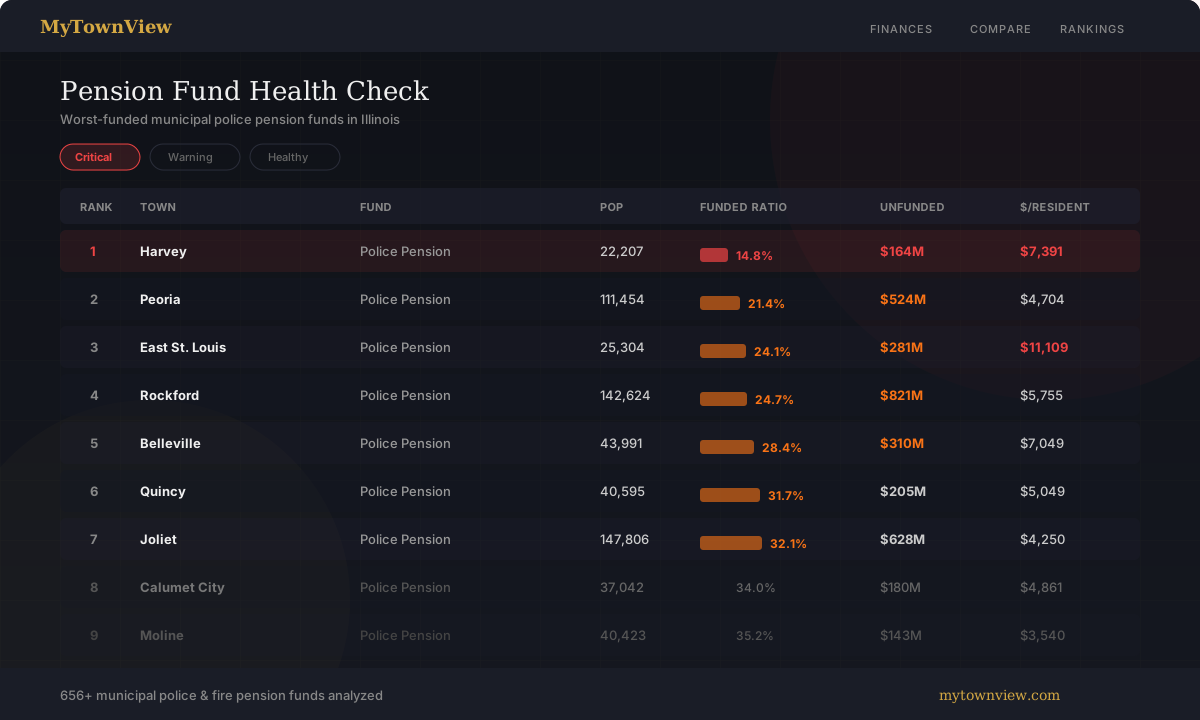
Correction (April 14, 2026): This article was substantially updated on April 14, 2026. The original version contained incorrect funded ratios, unfunded liability figures, and rankings that did not match data from the Illinois Department of Insurance. All pension data has been replaced with production-verified figures from IL DOI FY2024 actuarial valuations, and the rankings have been rebuilt from scratch. We regret the errors.
Illinois faces a pension crisis. Municipal police and fire funds are among the worst-funded in the nation. We analyzed which towns are on the brink and what it means for your property taxes.
Illinois has 512 municipal police and fire pension funds with data reported to the Illinois Department of Insurance. On average, these funds are 69.3% funded — meaning municipalities have set aside about 69 cents for every dollar they've promised retirees. Collectively, downstate police and fire pension funds carry $10.9 billion in unfunded liability. Statewide (including state-run systems like TRS, SURS, SERS, JRS, and GARS), Illinois is one of the worst-funded states in the nation.
This isn't an abstract financial problem. Unfunded pension liabilities are a hidden tax. They push property tax bills higher every year because municipalities must contribute more to catch up.
Why Are Pensions Underfunded?
A pension fund is funded when it has enough money set aside to pay all promised benefits to current and future retirees. A funded ratio of 100% is the target — every dollar promised is backed by a dollar saved.
A funded ratio of 50% means only half that dollar is there. The other half has to come from future employee contributions, employer contributions, or investment returns. As the ratio drops, it becomes harder to catch up because:
Investment returns fall short — Pension funds assume they'll earn 7-7.5% annually on their investments. When returns miss the target, the unfunded gap grows automatically.
Actuarial assumptions break down — Funds projected certain retirement ages and life expectancies. Changes in these patterns shift the math.
Contribution levels didn't rise fast enough — Many towns didn't increase what they paid into the fund when actuaries warned them to. By the time they did, the gap had compounded.
Costs spiral while collections lag — A pension obligation grows at 3-5% annually. If the fund only collects 2% growth in new contributions, the gap widens every year.
The result: municipalities are trapped in an actuarial challenge, paying more and more just to stay on track.
Which Illinois Towns Have the Worst-Funded Police Pensions?
These are the 15 worst-funded municipal police pension funds in Illinois, ranked by funded ratio from IL Department of Insurance data (FY2024):
| Rank | Town | County | Funded Ratio | Unfunded Liability | Pop | Unfunded/Resident |
|---|---|---|---|---|---|---|
| 1 | Riverdale | Cook | 14.9% | $45.1M | 10,340 | $4,358 |
| 2 | Lynwood | Cook | 17.5% | $13.4M | 9,083 | $1,477 |
| 3 | Stone Park | Cook | 21.4% | $17.5M | 4,482 | $3,901 |
| 4 | Burnham | Cook | 25.8% | $7.0M | 3,937 | $1,787 |
| 5 | East Alton | Madison | 29.0% | $7.8M | 5,689 | $1,363 |
| 6 | North Chicago | Lake | 29.2% | $48.4M | 30,643 | $1,580 |
| 7 | Lyons | Cook | 30.6% | $23.7M | 10,339 | $2,292 |
| 8 | Summit | Cook | 32.6% | $29.5M | 10,846 | $2,723 |
| 9 | Sauk Village | Cook | 34.9% | $12.2M | 9,678 | $1,259 |
| 10 | Island Lake | Lake | 36.8% | $6.5M | 8,014 | $807 |
| 11 | Danville | Vermilion | 36.9% | $50.9M | 28,595 | $1,780 |
| 12 | Lincoln | Logan | 37.3% | $18.8M | 13,281 | $1,419 |
| 13 | Fairfield | Wayne | 38.0% | $5.9M | 4,561 | $1,292 |
| 14 | Lansing | Cook | 38.8% | $69.9M | 28,284 | $2,471 |
| 15 | Orland Hills | Cook | 39.7% | $6.3M | 6,719 | $941 |
Source: Illinois Department of Insurance, Pension Data Portal, FY2024 actuarial valuations. Population: U.S. Census Bureau, 2024 ACS.
Riverdale stands out as the worst case. With only 14.9% funded and $45 million unfunded, Riverdale's police pension fund has less than 15 cents on the dollar. That translates to $4,358 in unfunded liability per resident.
Cook County dominates this list — 9 of the 15 worst-funded police funds are in Cook County municipalities. Many are small south suburban communities with shrinking tax bases and rising pension obligations. The six exceptions outside Cook span five counties: East Alton (Madison), North Chicago and Island Lake (Lake), Danville (Vermilion), Lincoln (Logan), and Fairfield (Wayne).
The Worst-Funded Fire Pension Funds
Fire pension funds show a similar pattern. Here are the 15 worst-funded fire funds in Illinois:
| Rank | Town | County | Funded Ratio | Unfunded Liability | Pop | Unfunded/Resident |
|---|---|---|---|---|---|---|
| 1 | Harvey | Cook | 22.0% | $43.1M | 20,230 | $2,133 |
| 2 | Lincoln | Logan | 24.3% | $18.0M | 13,281 | $1,353 |
| 3 | Danville | Vermilion | 29.0% | $56.0M | 28,595 | $1,959 |
| 4 | Evergreen Park | Cook | 32.7% | $2.5M | 19,420 | $127 |
| 5 | Blue Island | Cook | 33.1% | $18.5M | 21,741 | $851 |
| 6 | Rock Island | Rock Island | 35.0% | $57.6M | 36,151 | $1,593 |
| 7 | Forest Park | Cook | 39.2% | $27.5M | 13,943 | $1,970 |
| 8 | Chicago Heights | Cook | 39.3% | $62.4M | 26,736 | $2,334 |
| 9 | North Chicago | Lake | 40.4% | $20.5M | 30,643 | $668 |
| 10 | Cicero | Cook | 40.8% | $79.2M | 82,797 | $957 |
| 11 | Melrose Park | Cook | 41.1% | $61.2M | 24,549 | $2,495 |
| 12 | Mattoon | Coles | 43.3% | $29.0M | 16,586 | $1,745 |
| 13 | Streator | LaSalle | 43.7% | $9.8M | 12,330 | $798 |
| 14 | Rockford | Winnebago | 45.0% | $243.7M | 147,521 | $1,652 |
| 15 | DeKalb | DeKalb | 46.1% | $53.0M | 40,443 | $1,310 |
Harvey's fire fund is the worst in the state at just 22.0% funded — less than a quarter of what it needs. Harvey has been under state financial oversight for years, and its fire pension reflects the depth of the crisis: $43 million unfunded for a city of 20,000.
Rockford stands out for sheer dollar magnitude: $243.7 million unfunded in its fire pension alone. As one of the state's largest cities, Rockford carries enormous pension obligations that consume a growing share of property tax revenue.
The Towns That Got It Right: Best-Funded Police & Fire Funds
Not all Illinois municipal pension funds are in crisis. A number of towns have funded their obligations responsibly. These police funds are above 90% funded:
| Town | Fund Type | Funded Ratio | Assets | Unfunded Liability |
|---|---|---|---|---|
| Freeport | Police | 99.9% | $55.9M | $0.07M |
| Shiloh | Police | 98.7% | $10.4M | $0.1M |
| Rockton | Police | 97.9% | $10.3M | $0.2M |
| Sterling | Police | 97.1% | $30.9M | $0.9M |
| McHenry | Police | 96.8% | $62.4M | $2.1M |
| Bartonville | Police | 95.1% | $5.7M | $0.3M |
| Champaign | Police | 93.6% | $168.0M | $11.4M |
| Naperville | Police | 83.2% | $268.2M | $54.1M |
| Naperville | Fire | 86.2% | $270.4M | $43.4M |
| Champaign | Fire | 82.5% | $123.5M | $26.2M |
Freeport stands out at 99.9% funded — essentially fully funded. These towns prove it's possible to fund a pension responsibly in Illinois through consistent funding discipline. Most others haven't maintained that discipline.
The Hidden Property Tax Problem: Pensions Eating Your Tax Bill
Pension contributions consume a growing share of property tax revenue in many Illinois municipalities. When pension costs rise, something else gets cut — streets, parks, police operations, or basic city services. The municipalities with the lowest funded ratios are often the ones where property taxes are rising fastest, because they must make larger contributions to close the gap.
This creates a vicious cycle: higher taxes push residents and businesses to leave, shrinking the tax base, which concentrates the pension burden on fewer taxpayers, which pushes taxes higher still.
Why Small Funds Perform Worse Than IMRF
Illinois has two main pension systems: IMRF (Illinois Municipal Retirement Fund, a state-run multi-employer fund) and hundreds of individually managed municipal police and fire funds. IMRF-covered municipalities perform significantly better.
| System | # Funds | Avg Funded Ratio |
|---|---|---|
| IMRF (multi-employer) | 1 | 96.4% (IMRF Financial Results FY2024) |
| Individual police funds | 338 | 65.9% |
| Individual fire funds | 174 | 75.9% |
Individual police funds underperform IMRF by ~30 percentage points. Why? Scale and expertise. IMRF has billions in assets, professional investment staff, bulk purchasing power, and economies of scale. A town of 10,000 might have $5 million in police pension assets — it can't hire top investment talent, can't negotiate institutional-grade fund fees, and often relies on consultants.
IMRF also uses stricter actuarial assumptions (lower assumed returns), which forces discipline. Underestimating returns actually protects you long-term — when the market beats your assumption, you're ahead.
The Mandate That Keeps Shifting
Illinois law currently requires all municipal police and fire pension funds to reach 90% funded by 2040 (40 ILCS 5, Articles 3 and 4). The mandate has shifted before — originally 100% by 2033, then relaxed to 90% by 2040 in 2021.
Even that will require significant effort. For a fund at 35% funded today to reach 90% in 14 years requires strong investment returns, aggressive employer contributions, or both. Most towns are betting on investment returns. Few want to tell residents their property taxes are increasing further.
The Other Side: What the Crisis Narrative Misses
Before we conclude, it's worth examining the counterarguments — these aren't dismissible talking points.
Pensions are a promise, not a burden. Illinois police officers and firefighters accepted market-rate pay with the understanding that a defined-benefit pension would be there at retirement. The Illinois Constitution (Article XIII, Section 5) is unambiguous: pension benefits "shall not be diminished or impaired." The unfunded liability didn't emerge from generous benefits — it emerged from decades of municipalities treating required contributions as optional.
Funded ratios aren't as dire as they sound. A 50% funded ratio looks catastrophic. But pension funds don't need 100% of their money on the shelf today. They need enough to pay benefits as they come due over the next 30-40 years. As long as contributions and investment returns stay on track, an underfunded pension can still pay every dollar owed.
Consolidation is working. The Illinois Supreme Court upheld pension consolidation in January 2024. Early results are positive — when individual municipal funds merged into larger, professionally managed pools, investment returns improved and costs dropped.
Comparing worst-case funds to the average is misleading. The 15 worst-funded police funds are genuinely in crisis. But the average police fund is 65.9% funded, and 27 police funds are above 90% funded. The crisis is real but concentrated, not universal.
Is Your Town's Pension Fund Healthy?
What a good funded ratio looks like:
- 80%+ funded = Healthy. The municipality is on track, contributions are manageable, property tax burden is stable.
- 70-79% funded = Acceptable but aging. Watch for rising contributions.
- 60-69% funded = Warning. Contributions are likely rising. Property taxes may be increasing faster than inflation.
- Below 60% funded = Serious concern. Expect ongoing property tax pressure.
- Below 40% funded = Crisis. The municipality faces very difficult choices.
What unfunded liability per resident tells you:
- Under $1,000 per resident = Manageable.
- $1,000-$3,000 per resident = Significant burden showing up in taxes.
- $3,000-$5,000 per resident = Severe. Property tax increases are likely ongoing.
- Over $5,000 per resident = Distressed.
Methodology
Data sources:
- Illinois Department of Insurance, Pension Data Portal: FY2024 actuarial valuations for all municipal police (Article 3) and fire (Article 4) pension funds with reported data.
- Population: U.S. Census Bureau American Community Survey, 2024 estimates.
Coverage: 338 police pension funds and 174 fire pension funds with FY2024 data reported to the Illinois Department of Insurance. Note: Chicago's four pension funds (police, fire, municipal employees, laborers) operate under separate statutory frameworks and are not included in this analysis of downstate Article 3/4 funds.
Funded ratio calculation: Funded Ratio = (Actuarial Value of Assets / Accrued Liability) × 100
Unfunded liability: The difference between accrued liability and actuarial assets.
Unfunded liability per resident: Unfunded liability ÷ municipality population (2024 ACS).
Explore Your Town's Pension Data
Every municipality in Illinois with a municipal police or fire pension fund has a detailed breakdown on MyTownView. Browse funded ratios, unfunded liabilities, and contribution data for free.
Want to compare your town's pension health against similar-sized municipalities or neighboring towns? The Dashboard Compare tool lets you put up to five towns side by side across pension metrics and 100+ other financial indicators. The Rankings table lets you sort every municipality by funded ratio or unfunded liability per resident.
Both tools are available with a 14-day free trial.